



Historic Berwyn’s Bungalow Tour
Sunday September 29, 2019 – noon to 5 pm
Berwyn’s History — LaVergne
LaVergne: Thomas Baldwin
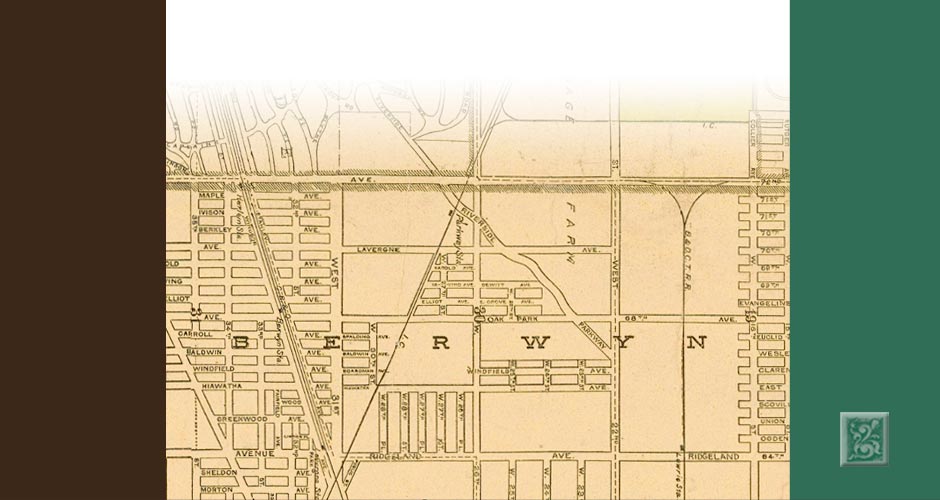
Berwyn’s development began in 1856 when Thomas Baldwin purchased 347 acres of land that he subdivided into large, 10-acre lots, hoping to market the idea that he named LaVergne as an all exclusive community for affluent residents. Baldwin invested heavily in this community; he built many roads and imported thousands of maple, ash, cedar, poplar, and pine trees, which were planted throughout the area that was bounded on the east by Ridgeland Avenue, on the west by Harlem Avenue, on the north by 31st Street, and by Old Plank Road (now Ogden Avenue and formerly U.S. Route 66), on the south.
At that time, the only mode of transportation between the LaVergne community and the City of Chicago was by the horse and buggy along Old Plank Road. In 1862 Baldwin sold an 80-foot wide strip of land to the Chicago, Burlington & Quincy Railroad, encouraging them to build a railroad extension to the new community. In the 1870s, residents built their own LaVergne Station along the new tracks at Ridgeland and Windsor Avenues. After Baldwin’s death, his daughter Emma sold a portion of LaVergne to a land syndicate headed by Marshall Field. In 1888, as the community grew, Cicero Township, which had jurisdiction over all of the area that is present-day Berwyn, Cicero, and Oak Park, built LaVergne School on a triangle of land bounded by Ogden, 34th Street, and Gunderson Avenue.
Swedetown
That same year, the Illinois Central laid tracks just north of LaVergne, bringing a group of Swedish immigrants who settled along 31st Street from East Avenue to Oak Park Avenue. The area, which became known as Upsala or “Swedetown,” soon became well known for its excellent craftsmen and bakeries.